

You don’t need to find the “best” Paris neighborhood — you need the one that fits your priorities.
For first-timers that usually means staying inside arrondissements 1–9 so sights are walkable, metro rides stay short, and streets feel safe after dark.
This post gives a quick, decision-ready checklist: what to pick if you want museums, romance, budget savings, family-friendly streets, or nightlife.
Use these simple rules of thumb to narrow choices fast and book with confidence.
How to Quickly Narrow Down the Best Paris Neighborhood for First-Time Visitors

Pick your Paris neighborhood by starting with walkability to major sights, metro access, and how safe it feels after dark. Most first-timers should stay inside arrondissements 1–9 to keep travel time down and stay close to the Louvre, Notre-Dame, and the Eiffel Tower. Marais, Saint-Germain-des-Prés, Latin Quarter, Montmartre, and the Eiffel area (7th arrondissement) get the most first-timer bookings because they balance convenience, atmosphere, and access to top attractions.
Marais puts you within a 20-minute walk of the Louvre and Centre Pompidou, with lively cafés and boutique streets everywhere. Latin Quarter offers student energy, Luxembourg Gardens, and the Pantheon at lower prices than other central zones. Saint-Germain-des-Prés delivers classic Left Bank café culture, safety, and elegance, but you’ll pay a premium. Montmartre gives you village charm and Sacré-Cœur views but requires climbing around 150 steps at some metro exits. The 7th arrondissement near the Eiffel Tower is quiet, upscale, and residential. It’s great if you want proximity to the tower and don’t mind fewer late-night dining options.
The fastest way to choose? Match your priorities to neighborhood strengths. On a tight budget, head for the Latin Quarter or a hostel in Marais. Want romantic streets and views? Pick Montmartre or Saint-Germain. If museums and central access matter most, book the 1st or 4th arrondissement. Use these decision rules to cut your search time:
- Best for budget travelers: Latin Quarter (5th) or hostels in Marais (3rd/4th)
- Best for couples and romance: Montmartre (18th) or Saint-Germain-des-Prés (6th)
- Best for museum and monument access: Louvre area (1st) or Marais (4th)
- Best for families and safety: Saint-Germain-des-Prés (6th) or Latin Quarter (5th)
- Best for quiet, upscale stays near the Eiffel Tower: Gros Caillou (7th)
- Best for nightlife and food scenes: Marais (4th) or Bastille (11th)
Paris Neighborhood Basics Every First-Time Visitor Should Understand

Paris has 20 arrondissements arranged in a clockwise spiral, starting at the center. The first nine arrondissements cover historic central Paris and contain most major tourist sights. Street signs display arrondissement numbers, and postal codes end with the arrondissement digits. 75001 means the 1st arrondissement, 75018 means the 18th. First-timers who book outside arrondissements 1–9 usually face longer metro rides and more time spent commuting instead of sightseeing.
Transport access determines how smoothly you move around the city. Metro lines 1, 4, and 8 connect most central neighborhoods to major attractions. Multi-day transport passes (2, 3, or 5 days) save money if you stay farther from walkable zones. Châtelet station in the 1st arrondissement serves as the main transport hub, with connections to metro lines 1, 4, 7, 8, 11, and 14, plus RER trains for day trips and airport access.
| Arrondissement Range | What It Means | Who It Fits |
|---|---|---|
| 1–4 | Historic center, major museums, tourist hubs | First-timers prioritizing walkability and convenience |
| 5–9 | Near-center districts, good metro access, cultural sites | Budget-conscious visitors and families who still want easy access |
| 10–20 | Farther from center, more residential, longer commutes | Repeat visitors, locals, or long-term stays seeking lower prices |
Comparing Paris’s Most Popular First-Time Neighborhoods

Marais (3rd and 4th arrondissements) gives you central access to the Louvre, Notre-Dame, Tuileries Gardens, and Centre Pompidou. All within a 20 to 25-minute walk. Metro lines 1, 7, and 8 run through the area, making connections to other parts of Paris fast. The neighborhood is full of boutique shops, galleries, Jewish Quarter bakeries on Rue de Rosiers, and outdoor terraces around Place des Vosges. Expect crowds during the day and higher prices than outer neighborhoods. But the walkability and atmosphere make it a top pick for first-timers who want lively streets and easy access to major sights.
Latin Quarter (5th arrondissement) sits on the Left Bank and delivers student energy, historic bookstores like Shakespeare and Company, and proximity to the Pantheon, Sorbonne, and Luxembourg Gardens. The Pantheon is about a 5-minute walk, Notre-Dame around 10 minutes, and the Louvre roughly 20 minutes on foot. Metro lines 4, 5, 7, and 10 serve the area, with line 4 offering direct access to Gare du Nord for train connections. This neighborhood costs significantly less than Marais or Saint-Germain while staying very central. That makes it great for budget-conscious families and students who still want walkable access to classic Paris landmarks.
Saint-Germain-des-Prés (6th arrondissement) offers Left Bank café culture, art galleries, and elegant streets near the Louvre, Musée d’Orsay, and Luxembourg Gardens. Walking time to Notre-Dame runs 10 to 15 minutes, and the Eiffel Tower is about 35 minutes on foot. Metro lines 4, 10, and 12 connect the area to the rest of Paris. This neighborhood ranks among the safest and most family-friendly, but it also sits among the most expensive. The atmosphere feels like storybook Paris, with local students, families, and tree-lined sidewalks.
Montmartre (18th arrondissement, south side) delivers village charm, cobbled streets, and panoramic views from Sacré-Cœur. Place du Tertre and the basilica sit about 5 minutes from many hotels in the area. But reaching Opéra takes around 30 minutes and Place de la Concorde around 45 minutes. Metro lines 2, 4, and 12 serve Montmartre, but some stations like Abbesses and Lamarck-Caulaincourt require climbing around 150 steps because of the neighborhood’s hillside location. Tourist crowds flood the area on weekends, and evenings turn quieter once day-trippers leave. This neighborhood suits couples and return visitors looking for a distinct, romantic atmosphere. It can be challenging for families with small children or travelers with mobility issues.
Eiffel Tower area (7th arrondissement, Gros Caillou) puts you 5 to 10 minutes from the Eiffel Tower on foot and about 30 minutes from the Arc de Triomphe. The Louvre sits roughly 40 minutes away by foot. Metro lines 8 and 10 run through the neighborhood. This area is quiet, residential, and upscale, with local grocers and the Rue Cler market street offering low-cost meal options. Late-night dining and budget restaurants are harder to find here than in Marais or Latin Quarter. The 7th works well for romantic trips and travelers willing to pay more for proximity to the Eiffel Tower and a calmer evening atmosphere.
- Marais: central, lively, lots of cafés; crowded and pricier
- Latin Quarter: budget-friendly, student vibe, very walkable; fewer upscale dining options
- Saint-Germain: safe, elegant, family-friendly; among the most expensive neighborhoods
- Montmartre: romantic views, village feel; hilly with stairs at metro exits, tourist-heavy on weekends
- Eiffel area (7th): quiet, near the tower, upscale; limited nightlife and cheap eats
Choosing a Paris Neighborhood Based on Your Travel Style

Families benefit most from Saint-Germain-des-Prés (6th) because of safety, proximity to Luxembourg Gardens, and family-friendly streets. Or from Latin Quarter (5th) when budget matters more and you still want walkable access to kid-friendly sites like the Pantheon and Jardin des Plantes. Couples seeking romance should aim for Montmartre for village charm and Sacré-Cœur views, or the 7th arrondissement for quiet evenings near the Eiffel Tower. Solo travelers, especially solo women, do well in the 1st or 6th arrondissements because of metro connections, safety after dark, and proximity to major attractions.
Food lovers will find the best dining variety in Marais, Canal Saint-Martin, and Bastille. Bakeries, bistros, wine bars, and international kitchens crowd the streets. Nightlife seekers and young groups should focus on Bastille (11th arrondissement) for bars and late-night energy. Or the Grands Boulevards area (2nd and 9th) for cafés and clubs that stay open until 2 or 3 a.m. Art and museum lovers should pick neighborhoods near the Louvre and Musée d’Orsay, such as the 1st arrondissement (Palais-Royal) or Saint-Germain on the Left Bank.
| Traveler Type | Recommended Neighborhood | Why It Fits |
|---|---|---|
| Families | Saint-Germain-des-Prés (6th) or Latin Quarter (5th) | Safe, walkable, parks nearby; 5th offers lower prices |
| Couples | Montmartre (18th) or Eiffel area (7th) | Romantic streets, views, quiet evenings |
| Solo travelers | Louvre area (1st) or Saint-Germain (6th) | Metro hubs, safety, walkability |
| Food lovers | Marais (4th), Canal Saint-Martin (10th), or Bastille (11th) | Bakeries, bistros, wine bars, international dining |
| Nightlife seekers | Bastille (11th) or Grands Boulevards (2nd/9th) | Bars, clubs, late-night cafés |
| Museum and art lovers | Louvre area (1st) or Saint-Germain (6th) | Walking distance to Louvre, Musée d’Orsay, galleries |
Safety and Convenience Considerations When Selecting a Paris Neighborhood
Pickpocketing is most common around the Eiffel Tower, on the steps of Sacré-Cœur, along metro line 6, at Gare du Nord, and at Châtelet station. Carry only essentials when visiting these spots. Keep a hand on your bag in crowded metros, and keep valuables concealed. The 6th and 7th arrondissements rank as the safest overall. Areas like Barbès, Château Rouge (north of Sacré-Cœur), and parts of Pigalle require extra caution, especially after dark.
The Gare du Nord area (10th arrondissement) is convenient for early train departures but feels less safe at night despite its transport usefulness. Parts of the 9th near Pigalle can involve catcalling and increased pickpocket risk, particularly for solo women. Some sections of the 19th arrondissement make even locals uncomfortable walking alone after dark. First-timers should prioritize neighborhoods where metro access doesn’t require long walks through poorly lit streets late at night.
When booking, verify that your accommodation sits within a 5-minute walk of a metro station on a well-traveled line like 1, 4, or 8. Check Google Street View to confirm the immediate block looks well-lit and populated. Avoid staying in the heart of party zones like Pigalle or Oberkampf if you want quiet evenings. Safety red flags include:
- Hotels more than a 10-minute walk from a metro station in outer arrondissements
- Locations north of Sacré-Cœur or near Barbès-Rochechouart metro
- Accommodations directly above or next to late-night bars in the 2nd, 9th, or 11th
- Budget options in the 19th or 20th arrondissements without clear transport access
- Streets that look deserted or poorly lit on mapping tools after sunset
Budget, Pricing, and Value Differences Across Paris Neighborhoods

Central neighborhoods cost more. The 6th and 7th arrondissements rank among the most expensive in the city. Hotels in Saint-Germain-des-Prés and the Eiffel area often run two to three times the price of similar quality accommodations in the Latin Quarter or 13th arrondissement. Hostels cost about one-third to one-quarter the price of hotels and offer the best value for solo travelers and groups willing to share dorm rooms.
Street croissants and pain au chocolat cost around €2, while hotel breakfasts can add €15 or more per person. Markets like Rue Cler in the 7th or smaller supermarkets throughout the city let you buy cheese, baguettes, and wine for low-cost dinners. The Latin Quarter and 13th arrondissement offer the cheapest hotel rates while still keeping you within reasonable metro reach of major sights. If you’re booking for a short trip of one to three nights, hotels in the 1st, 4th, or 5th arrondissements usually offer better convenience than budget options far from the center.
| Neighborhood | Typical Price Level | Budget Tips |
|---|---|---|
| Saint-Germain-des-Prés (6th) | Very expensive | Skip hotel breakfast; buy croissants on the street for €2 |
| Eiffel area (7th) | Very expensive | Use Rue Cler market for cheese and baguettes instead of restaurants |
| Marais (3rd/4th) | Expensive | Book hostels like The People Paris Marais for one-third hotel cost |
| Latin Quarter (5th) | Moderate to cheap | Central location with lower hotel rates; walk instead of paying metro fares |
| 13th arrondissement | Cheap | Significantly cheaper hotels; plan extra metro time to reach tourist zones |
Airbnb, Hotels, and Hostels: Which Paris Neighborhood Fits Each Option?
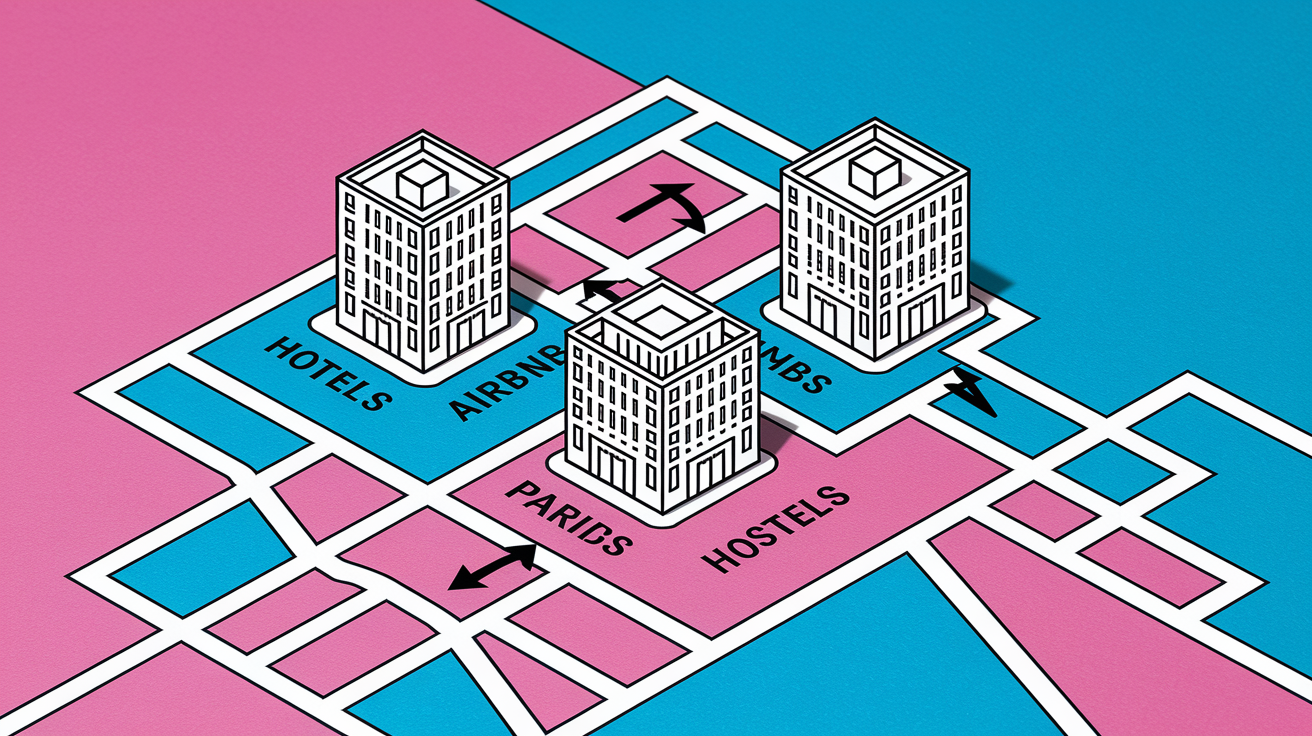
Hotels are recommended for first-time visitors because short-term apartment rentals in Paris face strict regulations. Booking an unofficial Airbnb can lead to last-minute cancellations or entry problems. Hotels offer daily cleaning, front-desk service, and simpler check-in processes, which reduce stress when you’re navigating a new city. For trips of one to three nights, hotels usually beat Airbnbs on convenience because you skip the cleaning fees, minimum-night stays, and stricter cancellation policies that often come with apartment rentals.
Airbnbs work better for families and longer stays when you want a kitchen, more space, and the ability to prepare meals at home. Expect to pay service fees, cleaning charges (often €50 to €100), and sometimes deposits. Cancellation rules on Airbnb can be less flexible than hotel policies, so read the fine print before booking. Neighborhoods like Marais, Latin Quarter, and the 7th have more hotel inventory and better transport access, making them easier for first-timers who choose hotels. Hostels concentrate in Marais, Canal Saint-Martin, and near Bastille, offering dorm beds and private rooms at one-third to one-quarter of typical hotel prices.
Examples of budget-friendly hostels include The People Paris Marais (dorms and private doubles on the edge of Marais), Generator Paris (central location with a rooftop bar and views toward Montmartre), and Le Village Montmartre (cheapest private-room option with breakfast included). Key lodging pros and cons:
- Hotels: reliable service, daily cleaning, easier check-in; more expensive in central arrondissements
- Airbnbs: kitchens, more space, good for families; watch for cleaning fees, minimum stays, and strict cancellation rules
- Hostels: one-third to one-quarter hotel cost, social atmosphere; shared facilities in dorms, less privacy
- Short trips (1–3 nights): hotels are more efficient and hassle-free than apartments with cleaning fees and check-in coordination
Areas and Neighborhoods First-Time Visitors Should Avoid

Pigalle (9th arrondissement) is lively and home to the Moulin Rouge. But staying in the heart of the red-light district can mean noise, catcalling, and pickpocket risk late at night. Visit for nightlife, but avoid booking a hotel directly on the main Pigalle blocks if you want quiet evenings. Champs-Élysées (8th arrondissement) is expensive, touristy, and farther from many other attractions despite proximity to the Arc de Triomphe. That makes it inefficient for first-timers who want to get the most sightseeing on foot.
Many double-digit arrondissements (10 through 20, except parts of the 15th near the center or 18th near Montmartre) are more residential and farther from central sights. Staying in these areas saves money but adds long metro commutes that eat into your sightseeing time. Barbès and Château Rouge, north of Sacré-Cœur, should be strictly avoided for walking alone at night. Parts of the 19th arrondissement can feel uncomfortable even for locals after dark.
Specific zones to skip for first-time stays:
- Pigalle red-light zone: good to visit, but avoid staying in the heart of the party area if you want restful nights
- Champs-Élysées and upper 8th: expensive, touristy, and farther from many sights; not efficient for first-timers on a budget
- Areas beyond the périphérique: poorly connected and far from tourist zones; only consider for long stays when budget is the top priority
- Barbès and Château Rouge (north 18th): unsafe at night; strictly avoid walking alone after dark
Final Checklist for Choosing a Paris Neighborhood

Use mapping apps like CityMapper or RATP to check walking times and metro connections before you book. Central arrondissements (1 through 9) reduce travel time and keep you within a 20 to 30-minute walk or short metro ride of major sights. Prioritize neighborhoods served by metro lines 1, 4, or 8 because these lines connect to the most tourist hubs and offer easy transfers. Confirm your hotel or rental sits close to safety-conscious zones like the 6th, 7th, or central Marais, and verify the immediate block looks well-lit and populated on Street View.
Run through these seven checks before finalizing your booking:
- Confirm the accommodation is within a 5-minute walk of a metro station on a major line (1, 4, 7, 8, or 10)
- Verify walking times to your top three must-see sights using a mapping app
- Check Street View to confirm the immediate block looks safe and well-lit after dark
- Read recent reviews for mentions of noise, safety issues, or difficult check-in processes
- Calculate total cost including cleaning fees, service fees, and breakfast charges to compare hotels and Airbnbs fairly
- Confirm the neighborhood matches your travel style (romance, nightlife, budget, family safety, food scene)
- Cross-check the address against known pickpocket hotspots (Eiffel area, Sacré-Cœur, Gare du Nord, Châtelet) and adjust booking if necessary
Final Words
Pick walkability and metro access first. Start with central arrondissements (1–9), then match vibe: Marais for museums and cafés, Saint‑Germain for quiet safety, Latin Quarter for budget walkability, Montmartre for romance and stairs, 7th for Eiffel views.
Use safety and price as quick filters, and prefer hotels for a smoother first stay. Check Lines 1 and 4 on a map, note pickpocket hotspots, and allow a 15–20 minute buffer for transfers.
If you need one rule for how to choose the best neighborhood in Paris for first-time visitors: prioritize convenience, then flavor. You’ll enjoy the city more for it.
FAQ
Q: How do I choose the best Paris neighborhood for a first-time visit?
A: The best Paris neighborhood for a first-time visit is in arrondissements 1–9; pick where you can walk to sights, have a 5–10 minute walk to a metro station, and feel safe at night.
Q: Which neighborhoods are best for first-time visitors in Paris?
A: The best neighborhoods for first-time visitors are Marais (central, museums), Saint‑Germain (cafés, safe), Latin Quarter (parks, student vibe), Montmartre (views, steps), and the 7th/Eiffel area (quiet, pricier).
Q: Is it better to stay in a hotel or an Airbnb for my first trip to Paris?
A: For a first trip to Paris, a hotel is generally better—fewer regulation surprises and clearer check‑in—while Airbnb gives space and a kitchen but may include extra fees and minimum stays.
Q: What Paris areas should I avoid, especially at night?
A: You should avoid parts of Barbès, Château Rouge, and some Pigalle blocks at night; also be cautious around Gare du Nord and busy transport hubs after dark for safety reasons.
Q: How important is metro access and which metro lines matter most?
A: Metro access is crucial; prioritize hotels near Line 1 (major attractions), Line 4 (Gare du Nord), and Lines 8/10 on the Left Bank to cut travel time and simplify sightseeing.
Q: Which neighborhoods are best for food lovers or nightlife?
A: For food lovers, choose Marais, Canal Saint‑Martin, or Bastille; for nightlife, pick Bastille or Grands Boulevards—but expect more noise and later crowds in those areas.
Q: Where are common pickpocket hotspots and how can I avoid them?
A: Common pickpocket hotspots include the Eiffel Tower, Sacré‑Cœur stairs, metro line 6, Gare du Nord, and Châtelet; avoid distractions, keep valuables zipped, and use a front‑worn bag or money belt.
Q: How do arrondissement numbers and addresses help me choose where to stay?
A: Arrondissement numbers show location—Paris spirals outward, and postal codes end with the arrondissement digit—so staying in 1–9 means closer to central sights and shorter travel times.
Q: Which neighborhood should I pick based on travel style (family, couple, solo, budget)?
A: For families pick the 6th or Latin Quarter for parks and safety; couples choose Montmartre or the 7th for romance; solo travelers favor the 1st or 6th for transit and safety; budget travelers try the 13th.
Q: What final checks should I do before booking a place in Paris?
A: Before booking, confirm arrondissement and map distance to nearest metro, read recent safety notes and reviews, check cancellation policy and check‑in time, and compare total nightly costs including fees.